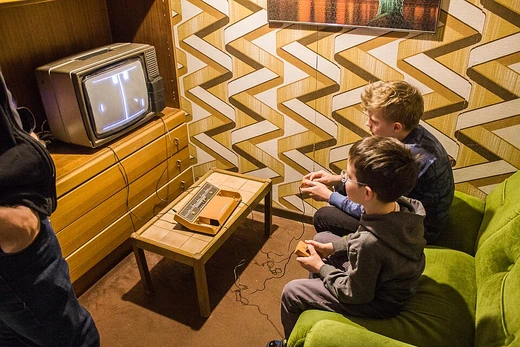
LJN Video Art
Educational drawing console with joystick and color slider.

The LJN Video Art, the only game console ever made by LJN, hit stores in 1987. Marketed as an educational device, it was sold for two years before being discontinued in late 1989 with a steep price cut. Critics mostly hated it, but it briefly ranked among hot holiday toys. Eight cartridges were produced for the system.
Its core function was like a basic computer paint program. A joystick controlled a cursor to draw lines and curves, while a slider selected from 16 colors. Without a cartridge, the system showed a blank screen for freehand drawing. The game library consisted of themed coloring books. Users could create animations by drawing a series of images and recording them as a slideshow onto a VCR. The included Video Art Activity Cartridge provided outline drawings to color.
The eight cartridges were: Video Art Activity Cartridge, A Trip To The Zoo, Disney Coloring Book, Disney Story Book, Looney Tunes, Marvel Super-Heroes, My Dream Day, and On the Move.
- field
- Home video game console
- known_for
- Educational drawing console with joystick and color slider
- launch_year
- 1987
- discontinued
- Late 1989
- manufacturer
- LJN
- games_produced
- 8
Lore & Background
The LJN Video Art was developed and manufactured by LJN, launched in 1987. Its core functionality was similar to basic personal computer paint programs, with a joystick controlling a cursor to draw lines and curves, and a slider to select up to 16 colors. Turning on the system without a cartridge gave a blank screen for drawing. The library was based on themed coloring books, and animations could be made by creating a series of drawings and recording a slide show to a VCR. The included Video Art Activity Cartridge had several outline drawings that could be colored. Eight game cartridges were produced, including titles such as A Trip To The Zoo, Disney Coloring Book, and Marvel Super-Heroes.
Reader's Guide
The LJN Video Art was positioned against a wide range of educational toys and interactive television systems, such as View-Master Interactive Vision and VideoSmarts, and against television itself. It was sold alongside, but not directly positioned against, mainstream game consoles like the Nintendo Entertainment System and the Master System. A patent was filed in 1986 and granted in 1988. In 1987, LJN spent most of its $5 million TV and print advertising budget on Gotcha! and Video Art. A TV advertisement included a rap-style beat. In December 1987, Toys R Us reported that the Video Art at about US$100 was among its 'hot toys' for Christmas, alongside the NES and talking dolls. However, the console was mostly panned by critics. USA Today called it 'A costly color Etch-a-Sketch for your TV set that's much harder to work and not much fun.' Roger Ebert remarked that 'the results look crummy.' Catherine Cella found even simple drawing impossible. James Rolfe of The Angry Video Game Nerd called it 'a disaster.' The console was discontinued in late 1989 at a heavy price drop, as ultimately a commercial failure.
Did You Know?
- The LJN Video Art is LJN's only video game console.
- Eight games were produced for the system.
- A patent for the console was filed in 1986 and granted in 1988.
- In December 1987, Toys R Us listed the Video Art among its 'hot toy
More in Drawing video games 1-24
Spotted an error? Know more?
This is a living reference — every entry is fact-audited, and reader corrections feed straight into our audit queue. Suggest an edit · See this site's audit record